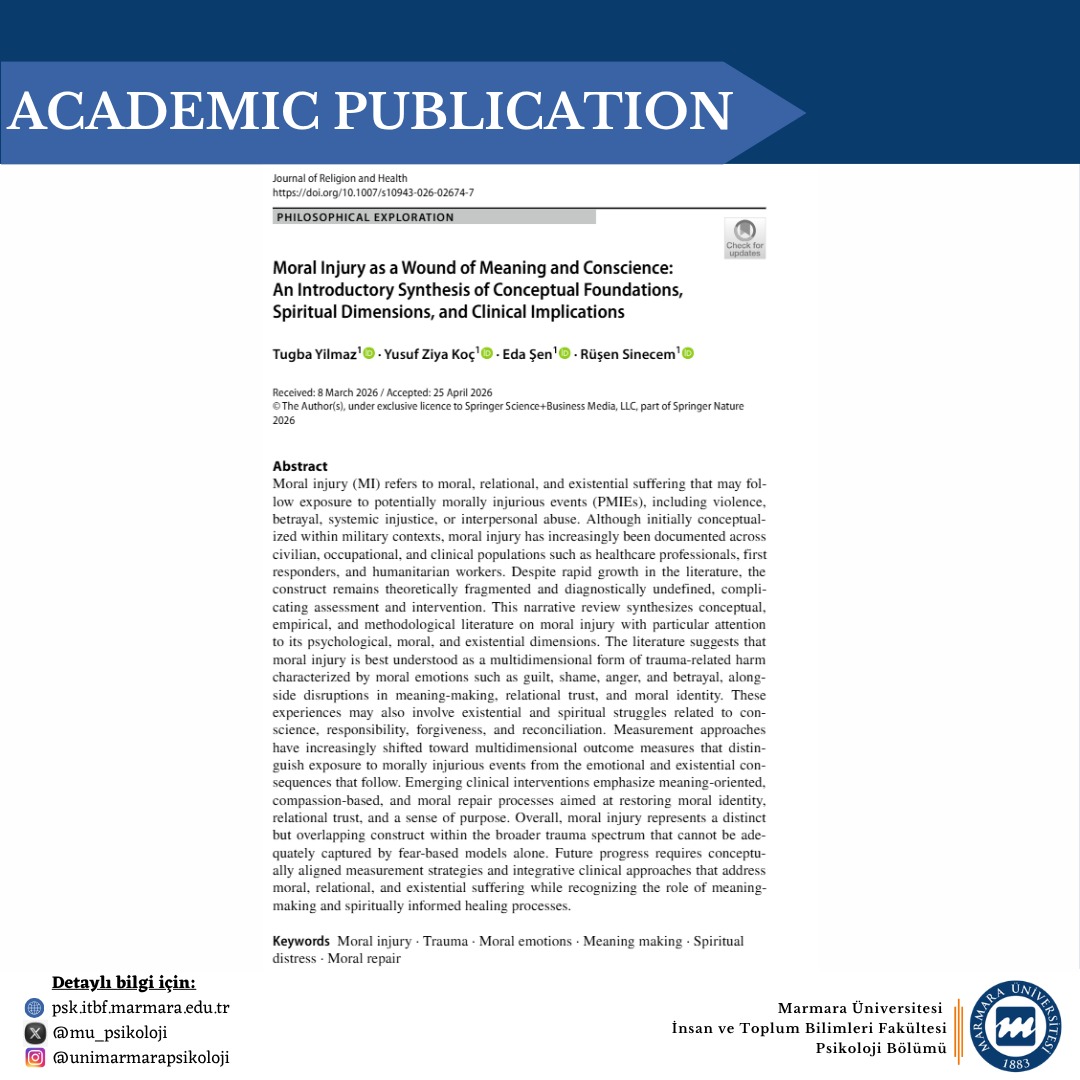
A study conducted by our department’s faculty members Assoc. Prof. Dr. Tuğba Yılmaz, Res. Asst. Yusuf Ziya Koç, and Res. Asst. Eda Şen has been published in the Journal of Religion and Health.
Moral injury (MI) refers to moral, relational, and existential suffering that may follow exposure to potentially morally injurious events (PMIEs), including violence, betrayal, systemic injustice, or interpersonal abuse. Although initially conceptualized within military contexts, moral injury has increasingly been documented across civilian, occupational, and clinical populations such as healthcare professionals, first responders, and humanitarian workers. Despite rapid growth in the literature, the construct remains theoretically fragmented and diagnostically undefined, complicating assessment and intervention. This narrative review synthesizes conceptual, empirical, and methodological literature on moral injury with particular attention to its psychological, moral, and existential dimensions. The literature suggests that moral injury is best understood as a multidimensional form of trauma-related harm characterized by moral emotions such as guilt, shame, anger, and betrayal, alongside disruptions in meaning-making, relational trust, and moral identity. These experiences may also involve existential and spiritual struggles related to conscience, responsibility, forgiveness, and reconciliation. Measurement approaches have increasingly shifted toward multidimensional outcome measures that distinguish exposure to morally injurious events from the emotional and existential consequences that follow. Emerging clinical interventions emphasize meaning-oriented, compassion-based, and moral repair processes aimed at restoring moral identity, relational trust, and a sense of purpose. Overall, moral injury represents a distinct but overlapping construct within the broader trauma spectrum that cannot be adequately captured by fear-based models alone. Future progress requires conceptually aligned measurement strategies and integrative clinical approaches that address moral, relational, and existential suffering while recognizing the role of meaning-making and spiritually informed healing processes.


