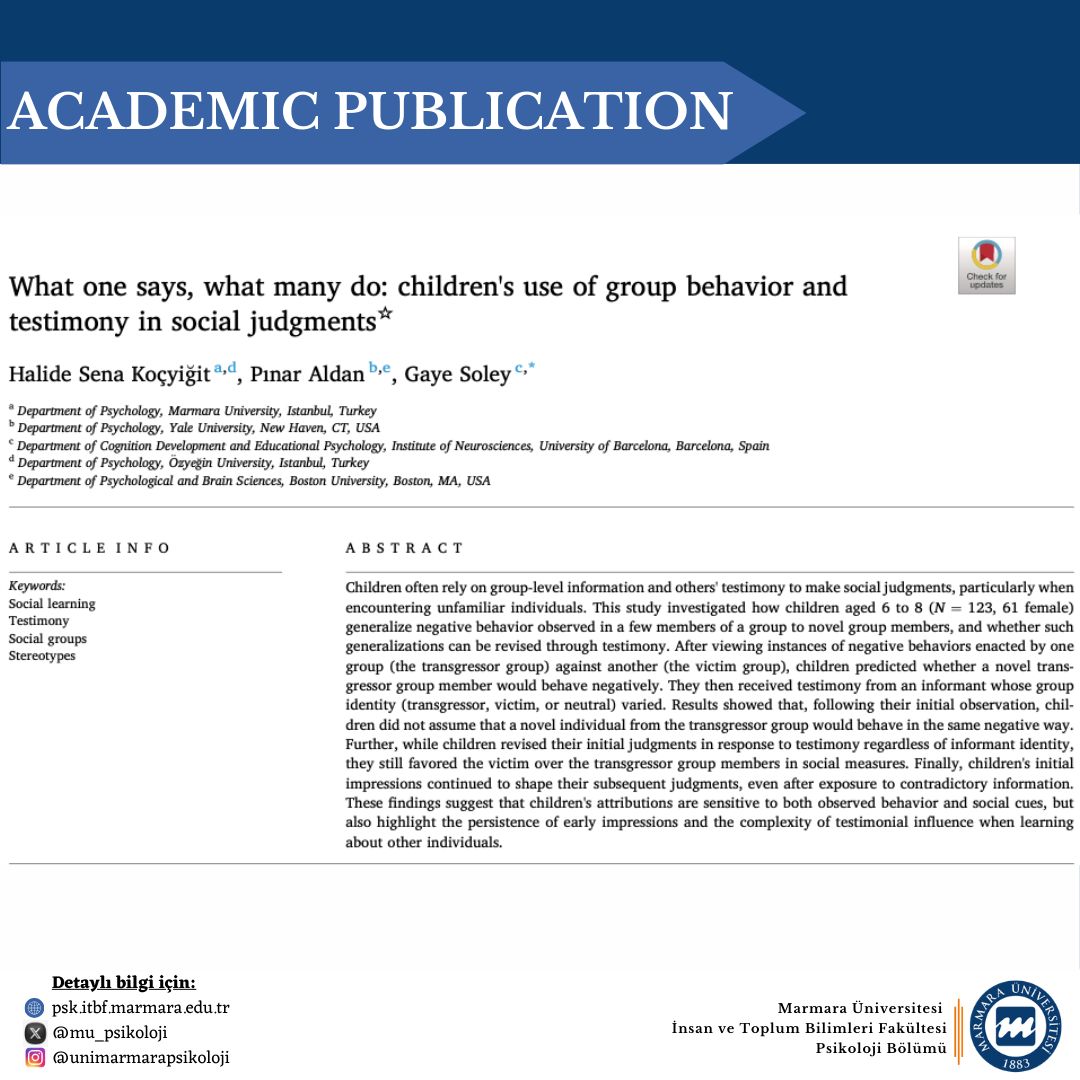
A study conducted by Research Assistant Halide Sena Koçyiğit, one of the academics in our department, together with her colleagues, was published in the journal Acta Psychologica.
Children, especially when they encounter unfamiliar individuals, generally rely on group-level information and others’ statements to make social judgments. This study investigated how children aged 6 to 8 years (N = 123, 61 girls) generalize the negative behaviors they observed in a few members of a group to new group members and whether these generalizations can be revised through testimony. After observing examples of negative behaviors displayed by one group (the perpetrator group) toward another group (the victim group), children predicted whether a new member of the perpetrator group would behave negatively. Subsequently, they received testimony from an informant whose group identity (perpetrator, victim, or neutral) differed. The results showed that, after their initial observations, children did not assume that a new individual from the perpetrator group would behave in the same negative manner. In addition, although children revised their initial judgments in response to testimony regardless of the identity of the information source, they still preferred members of the victim group over members of the perpetrator group in social evaluations. Finally, children’s initial impressions continued to shape their subsequent judgments even after exposure to conflicting information. These findings indicate that children’s attributions are sensitive both to observed behaviors and to social cues, while also emphasizing the persistence of first impressions and the complexity of the influence of testimony when learning about other individuals.


